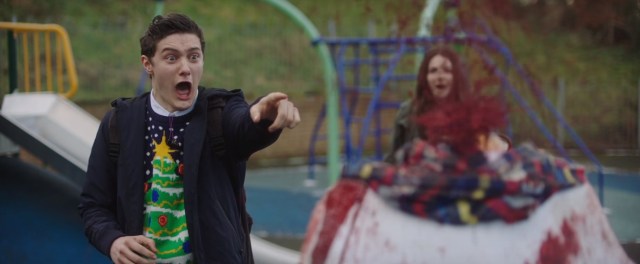
If the above description of forthcoming movie, Anna and the Apocalypse (a Scottish, teenage zombie, high school musical for those who can’t remember anything above the header photo), doesn’t grab your attention as much as it does mine, then you’re probably reading the wrong blog. Oh, it’s also set at Christmas, but at this time I can’t confirm the involvement of either Tim Burton or Shane Black.
The film isdirected by John McPhail, and stars Ella Hunt, Mark Benton, Paul Kaye and includes up-and-comers Malcolm Cumming, Sarah Swire, Christopher Leveaux, Ben Wiggins and Marli Siu.
Beyond its screening at this week’s Fantastic Fest in Austin, release details seem a little sketchy, but frankly the sooner this apocalypse is released upon the world the better.
In 2014 Universal released Dracula Untold and bravely announced it would be the first of a Marvel Cinematic Universe-style reboot of their classic stable of monster characters. Despite a reasonable return at the box office, this toothless retread received a decidedly lukewarm reception and it seemed the studio’s monsterverse was stillborn.
Jump ahead a few years and Universal announce another stab at The Mummy, which will herald in the first (or rather, the first yet again) of its Dark Universe films (now playing down Dracula Untold’s connection and seemingly forgetting poor old Luke Evans’ Transylvanian Count in the process).
This latest catalogue of Egyptian shenanigans has more in common with the previous trio of movies headlined by Brendan Fraser (The Mummy, The Mummy Returns and The Mummy: Tomb of the Dragon God) than the 1932 original starring Boris Karloff (or that film’s four successors). This means we’re in for another round of big budget, high adventure rather than anything remotely horrifying.
Tom Cruise is dull and woefully miscast, in a role that might have worked better with someone more adept at comedy (I kept thinking of Bruce Campbell), as a none-too-bright treasure hunter (read: thief) who inadvertently revives an evil Egyptian Princess with a plan to find a human host for the god, Set. The Princess has her eyes on Tom (presumably for the way he looks, because his character is rather irritating), and once Set moves in they’ll… I don’t know, take over the world, or yada yada, blah blah. It’s entirely possible I may have zoned out for a moment or two and missed some of the finer details.
This kickstarts a lot of big action set pieces, some dire attempts at comedy (including a huge and completely inappropriate swipe from John Landis’ seminal An American Werewolf in London), a lot of running around and away from dull CGI, and not one sequence that manages to be creepy or horrifying. Rather unfortunate for a would-be horror franchise, I’d say.
Russell Crowe shows up in an attempt to be the glue which holds together the Dark Universe but settles instead for chewing huge chunks of scenery and (presumably unintentionally) hilariously descending into a Mary Poppins/Dick Van Dyke Cockernee accent when his Doctor Henry Jekyll begins to play Hyde and seek. #sorrynorsorry
Sofia Boutella, as Princess Ahmunet/The Mummy, tries hard to do something with her role, managing to reveal shades of vulnerability through the bandages, through sheer force of will rather than anything the script gives her. It’s a shame the writers, producers and director didn’t trust the actress with more to do.
It’s astonishing and sad that Warner Bros/DC and now Universal have looked at the Marvel movies and learned nothing whatsoever from their success. When will studios understand that trying to shoehorn a shared universe into one movie is a bad idea!?
The film feels like nothing more than a checklist designed by a committee who wanted to tick off as many boxes as possible for Tom Cruise fans, giving them the kind of action they’ve grown used to from the Mission: Impossible series. Sadly this committee have seemingly never actually watched, or at least understood, a horror movie (and certainly none of the studio’s original films from the 1930s and 1940s), because bolting together a Tom Cruise action movie and a horror movie with no horror is most definitely a failed experiment that would have Doctor Frankenstein hanging his head in shame.
Finally and lethally, The Mummy is boring, it isn’t scary and the Dark Universe it tries so desperately to unwrap is dead on arrival.
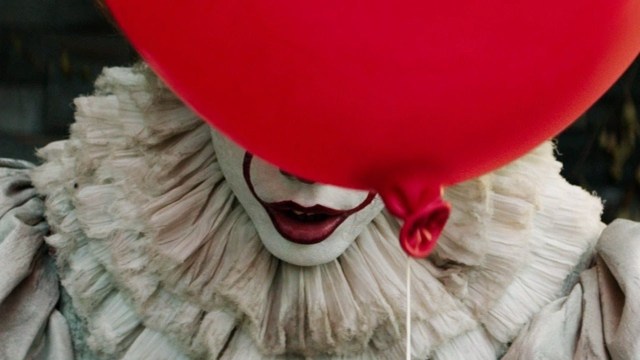
Yes, yes, we all know no one can ever truly replace Tim Curry’s underpants-worrying Pennywise, but damn, folks, this trailer promises mighty creepy things!
Based on one of Stephen King’s best books, this new version of IT is directed by Andy Muschietti and is promised as the first of two films (the second dealing with, well, whichever characters survive their encounter with Pennywise the clown in this installment).
I love Tommy Lee Wallace’s 1990 mini-series fiercely (even despite the deficincies with its ending… yeah, yeah, that spider…) and Tim Curry has given so many people clown-induced nightmares – not to mention provided the scariest internet memes – but I’m totally down with what Warner Bros seem to be serving up here.
IT opens on September 8th in the U.S. and is pretty much guaranteed to make you scared of clowns forever. If, like me, you aren’t already…
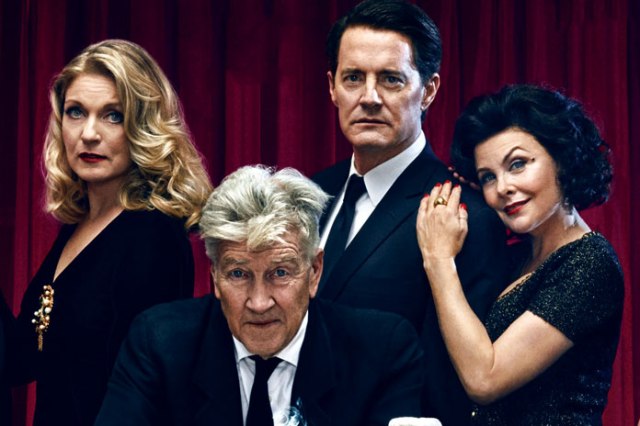
Writing a review of the first two episodes of Twin Peaks, or Twin Peaks: The Return, if you will, is a difficult task for a number of reasons.
Firstly, reviewing any David Lynch production is tantamount to trying to explain a night of fractured dreams to someone using only the art of mime. No amount of wild gesticulation can adequately communicate so much that’s based on symbolism and mood. Lynch’s tales come complete with codes to be deciphered and visuals and sound that defy narrative description but stain themselves onto the viewer’s psyche like blood on a carpet.
Secondly, these first two episodes are part of what Lynch sees as one eighteen hour long movie broadcast across consecutive weeks, so trying to make sense of the overall narative arc now is an impossibility. Especially given the Lynchian parameters as mentioned above.
What I can say is that it is both the Twin Peaks longtime viewers have come to love (or loathe) and yet it isn’t.
Familiar characters are introduced leisurely across episodes one and two (and “leisurely” is a word I’ll come back to), particularly in regards to Agent Dale Cooper still being stuck in The Black Lodge after twenty five years, but we’re also thrown into the deep end with a bunch of new characters – a young man in New York city watching a strange glass box, a principal in Buckhorn, South Dakota who may or may not be responsible for the brutal killing of his school librarian.
These new locales (and the vastly enlarged cast, including Matthew Lillard, Ashley Judd and Jennifer Jason Leigh in episodes one and two) open up the canvas of the series, giving a much more expansive feel to events. How Lynch will tie all these together with the more familiar surroundings of Twin Peaks (the town) is anyone’s guess. Or maybe he simply won’t.
Lynch moves everything along at a deliberate, leisurely pace, sometimes wonderfully frustratingly so. The episodes feel like absolutely nothing else on TV right now and that is a complete joy. The thought of spending another sixteen hours being amused, mystified, frustrated, amazed and horrified makes me give a big Cooper-like thumbs up to see how television drama has evolved to a point where an idiosyncratic master of dreamscape storytelling like Lynch can be afforded the opportunity to unfurl his tale in exactly the way he wants, at the pace he wants, without the horror of network executive notes telling him to hurry things along because he might lose those viewers not up for the journey.
Massive bouquets of blue roses should be showered upon Showtime for giving Lynch the room to breathe that modern cinema seems to have lost the possibilty of doing.
If you love his work, Twin Peaks: The Return will be like mainlining pure David Lynch. If you’ve resisted his unusual charms then this might not be the show for you. If you’re a complete newbie, then you’re in for an experience like nothing you’ll have seen on TV before: treading the gossamer line between dream and nightmare.
Either way, load up with pie, donuts and coffee, buy the ticket and take the ride. Who knows where Lynch and Twin Peaks will take us!? But I have a definite feeling it will be a place both wonderful and strange…
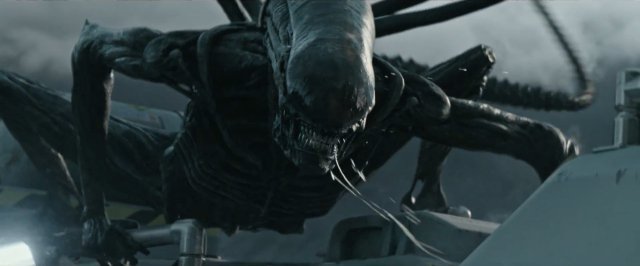
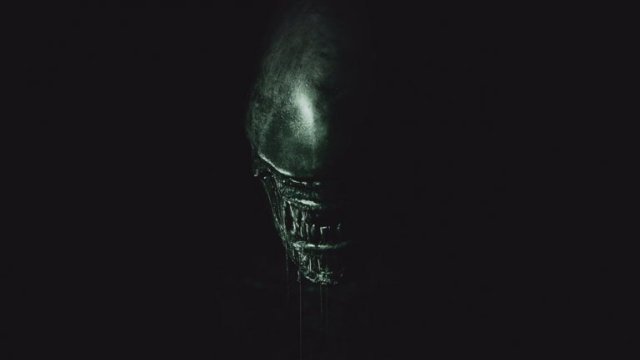
When Ridley Scott returned to the Alien franchise with Prometheus in 2012 hopes were high that the venerated director would give audiences the kind of scares associated with his original 1979 classic. What we got instead was a disjointed meditation on creation with a group of characters whose actions often seemed more alien than the series’ title creature.
During production of Alien: Covenant word of mouth suggested that Scott and the production team had taken onboard complaints that Prometheus had strayed too far from the formula and that this time… this time… we would see our beloved xenomorph restored to its full, chest-bursting glory.
Picking up ten years after we last saw Noomi Rapace and Michael Fassbender (as Dr Elizabeth Shaw and David) wander off into deep space to find mankind’s creators, we focus now on the crew of the colony ship, Covenant, heading for a remote planet, Origae-6, with two-thousand colonists and a thousand embryos on-board, monitored by an upgraded android resembling the earlier David, named Walter (also played by Fassbender).
Of course things go wrong on the mission and the ship is soon taking a detour to investigate a human signal coming from an alien planet – seemingly also ripe for colonisation.
Before you can say “In space, no one can hear you scream” the landing party runs into further trouble and for a while the film seems to be leading us along a familiar path with new forms of alien creatures, the neomorphs, making short work of everyone.
Then Fassbender’s David reappears and the film lurches into gothic Hammer horror territory. This might seem like an intriguing diversion but while Covenant IS more of a horror movie than Prometheus, Scott and his writers appear to have lost all interest in the alien. The real monster here is David, serving as Victor Frankenstein to the now dethroned star of the franchise.
Events reach a climax on the planet and the survivors return to the Covenant for a bizarre and utterly shoehorned in final fifteen minutes which attempts to recreate elements of both Scott’s 1979 original and James Cameron’s equally loved 1986 sequel, Aliens.
I have too much respect for Scott to suggest that Covenant’s Reader’s Digest abridged-version finale was a studio-dictated necessity but that is, sadly, exactly what it feels like. Events are rushed through and more crew members are dispatched with such rapidity that it would be easy to miss the true (and highly effective) horror enacted by David in the film’s final moments.
There are two movies struggling against each other, the attempted return to the scary roots of the franchise and the story Scott and co. are really interested in, that of David and Walter and the struggle with what they are, where they come from and their quest to find answers among the stars – which provide some of the most interesting moments of Covenant. Sadly, these two movies fail to cohere and we’re left with a story that satisfies neither requirement.
Scott is far too good a director for Covenant to be a disaster: there’s lots to enjoy and admire and there are moments of beauty, of intrigue and of genuine horror (and also, sadly, of unintentional humour… the baby alien raising its arms to copy David is a series low point). Unfortunately the ambition to turn the franchise into something of wider philosophical concerns dilutes the simple funhouse horror of the central creature, leaving him somewhat toothless and the film itself oddly schizophrenic.
Fox have just released this four minute prologue sequence for their upcoming Alien: Covenant, not part of the film itself and directed by Luke Scott, Ridley’s son.
Rather encouragingly, these four minutes contain more recognisable human qualities than the entire two hours of Prometheus, as we’re deftly introduced to the crew of the colony ship Covenant just before they enter cryosleep.
James Franco, Danny McBride, Katherine Waterston and Michael Fassbender are all front and centre, with Fassbender as Walter, a different android character to that of David from Prometheus, last seen as a collection of body parts jetting off into the unknown with Noomi Rapace.
How that film’s ending ties into Alien: Covenant remains to be seen, but this new production obviously feels confident enough to land one mother of a joke at the expense of the original Alien’s now-classic dinner scene with John Hurt.
All of which bodes well for Alien: Covenant. At least it can’t be any worse than Prometheus, right!? Right, Ridley…!?
Okay, it’s Christmas Day, and what better way to celebrate than with the new Red Band trailer for Alien: Covenant.
After being teased (some might say over teased) by a slew of photos from Fox, the studio has finally released the trailer for Ridley Scott’s newest trip into the world of Xenomorphs and Michael Fassbender.
The stink of Prometheus is still pretty strong, but the trailer is certainly a strong statement that this will take the franchise back to its scary basics, and since advance word is sounding good there’s reason to be cautiously optimistic.
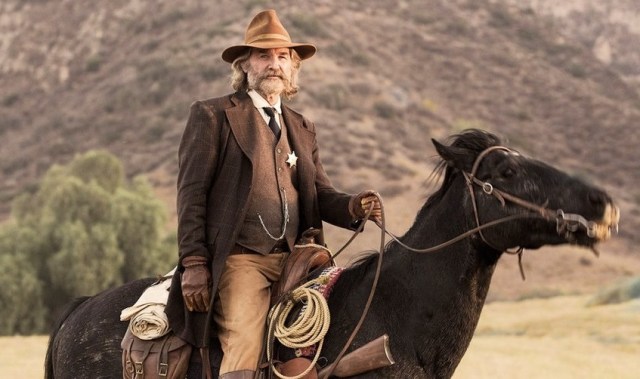
Every now and then a movie comes along that just calls to you, that feels like someone you meet and instantly know will become a friend. When I first read about Bone Tomahawk, a Western/cannibal hybrid with Kurt Russell, I said to myself “That’s a film made just for me if ever I heard of one!” and sure enough, I was thrilled and delighted with this brutal, wonderful gem.
Taking its place in the compact but often interesting genre of horror Western, S. Craig Zahler has stuffed his story with an excellent cast and structures it as a slow build that expertly winds up the tension. Kurt Russell, who just gets better with age, strides through the film with rugged ease (and another magnificently crafted moustache) and leads a posse out into some seriously badlands to retrieve townfolk taken by a raiding party of not-quite-Native American Indians. To say much more would spoil your enjoyment, but the film mixes elements of John Ford’s The Searchers with the gruesome horrors of Cannibal Holocaust and The Descent.
What gives the film its true power is the first hour spent in the company of the townspeople and the posse, deftly giving us characters to care about and root for. Lost’s Matthew Fox, Watchmen’s Patrick Wilson and the always dependable Richard Jenkins all work well together and there is much humour in the journey, making the eventual horrors even more unbearable.
Thankfully, Zahler resists the urge to go by-the-numbers, and the somewhat low key ending feels satisfying for a film that both plays by genre rules while bending them. The film is a great mixture of charm and brutality that won’t win over everyone but will find itself championed by those with a taste for films that stray off the beaten path.
Saddle up and settle in for the ride, just make sure you don’t eat while you’re watching.
Whether, like me, you feel the zombie genre hasn’t offered anything new or exciting in a while, or whether you’re still in thrall to the wave of undead films, games and TV shows swarming across our screens, Train to Busan will offer up fresh meat on those rotting bones. To put it simply, this South Korean horror movie has become a late entry on my top films of the year.
The plot is straightforward; a disparate group of passengers board a train just as we are given glimpses that something bad is happening around them. The bad thing, of course, is a zombie apocalypse and director Yeon Sang-ho handles the perfectly timed build like a master, cluing us in ahead of the characters just enough so we feel the noose tightening around them.
Really, saying anything more than that regarding the plot would just spoil the fun for you, suffice to say that all hell breaks loose and the passengers of the train must survive long enough to reach the promised safety of the final stop, the city of Busan.
The film knows what it wants to be and revels in the pleasure of a non-stop barrage of thrills and chills. But, much like George Romero’s high point in the zombie genre, Dawn of the Dead, Sang-ho uses the film to make some barbed comments on society. That it makes them is worthy of attention and even though the film makes them a little bluntly on occasion these moments tend to be undercut with character building emotion, so they’re rarely wasted. One particular revelation is actually groan-worthy in its attempt to tie things up too neatly, but the director is smart enough not to linger on it too long before leaping into the next bravura sequence.
And bravura these sequence are. In the interests of keeping this review spoiler free I’ll just mention a favourite, prolonged sequence where our core group of passengers attempt to rescue another group trapped at the rear of the train, meaning they will need to pass through several train cars of zombies – and back again. It’s a sustained line of set pieces highlighting both the film’s ease with character development and its ability to ratchet up the tension, making smart use of some interesting wrinkles on the usual zombie characteristics and in particular of the location and its surroundings. You might even shed a tear or two.
There are some clichés here to be sure (the noble sacrifice gets more than one airing), but Sang-ho and writer, Park Joo-suk give their characters enough life (the living ones at least) to carry you through any hiccups and do enough with the nail-biting action and visuals to make this a first class journey (…oh come on, I had to say it at some point in this review).
Train to Busan is a wonderful, high concept action/horror movie told with breathtaking confidence. Stylish, elegant and exciting, this is destined to become a major cult horror movie, regarded in the same revered breath as John Carpenter’s run of work from the late 1970s through the 1980s. A far less interesting Hollywood remake surely beckons.
Just when you think there’s little left to be said or done with the walking dead, along comes a movie which shows there’s life in those shambling old creatures yet.
Big Ronnie is a grinning grotesquerie who wanders around in a series of bizarre outfits, frequently with his nasty-looking penis dangling halfway to his knees. When he isn’t dragging his poor emotionally stunted, needy son, Big Brayden, around to present a tourist trap disco tour of derelict locations, Ronnie covers himself in layers of thick grease and violently murders anyone who crosses him. Or even poor, hapless souls who don’t cross him. Ronnie is not exactly picky when it comes to strangulation.
Underneath the unwashed y-fronts, (literally) in your face fart gags and dangling penises there beats a curiously affecting, albeit diseased, heart. The murder plot eventually gives way to the story of a father and son finding each other after years of emotional abuse, before tailing off into a deep end of… well, actually, I’m not sure exactly what happens at the end. There might be a point to it all, but I’m not sure it actually matters if there isn’t. At the very least you’re sure to come away from a viewing wanting to sing and dance to the line “Hootie Tootie, Disco Cutie!” As cinematic gifts go, that’s pretty decent.
There’s nothing remotely real-world about Jim Hoskings’ film, and yet it’s not difficult to imagine these characters existing on the fringe of society, too out there even to be featured on reality TV shows and living on the same block as Pink Flamingos’ Egg Man and Connie & Raymond Marbles, or even Blue Velvet’s Frank Booth in a lighter mood.
Imagine a film that has some of the oddball feel of a Napoleon Dynamite sequel as made by John Waters, featuring a synth-driven electro pop score, with lashings of sex, gore and greasy murders, and you’ll get a good feel for what you’re letting yourself in for. There are moments of such out and out goofiness (Ronnie’s spotlit, street disco solo – all wild hair, gangly legs and dangly cock – being a prime example) that you can’t help but warm to the strangeness being thrust in your face.
The three leads (Michael St. Michaels, Sky Elobar, Elizabeth De Razzo) give fearlessly physical, genuinely off-kilter performances, putting Jared Leto’s pissant Suicide Squad Joker to shame with what they dare to do for the camera, and still manage to make their characters just a little more than cartoons, giving their three way love triangle more heart than the constant anal fingering might suggest. But don’t worry if you think it’s all going to get too touchy-feely… there’ll soon be a phone sex scene of junior furiously fiddling with his infintesimal cock while mouthing sweet nothings to his amore, such as “Imagine me stroking your clitoris with a pink feather and then you cradle my sack.” This might be the film that the acronym WTF was made for.
The Greasy Strangler is, as they say, not a film for everyone. But it is one of the more bizarre and frequently laugh out loud funny films I’ve seen in a long time. It also has the best and most disgusting prosthetic movie wang since Mark Wahlberg’s Boogie Nights dazzler. So you know you’re getting bang for your buck.






 out of dave's head