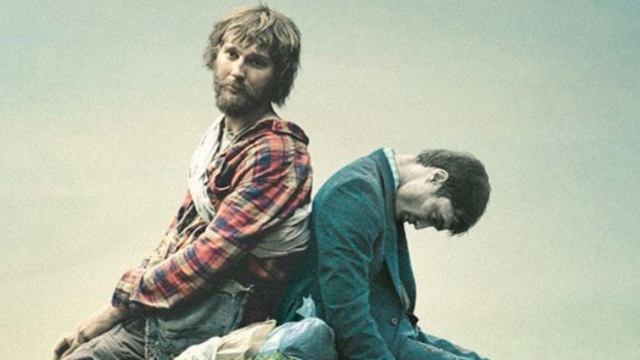
What if I were to tell you that the most heartwarming, life affirming movie of the year involves the farting corpse of Harry Potter showing Paul Dano the meaning of friendship and love? I should mention that it also verges on being a musical.
If that seems unlikely, then the opening of the film, written and directed by Daniel Scheinert and Daniel Kwan, will do little to persuade you. Dano, marooned and hysterically lonely on a tiny desert island, is attempting to commit suicide before being saved by the appearance of Daniel Radcliffe’s flatulent corpse washing up on the beach.
What follows next is a journey, both geographically (although that might be part of a grander delusion) and emotionally, of these two lost souls, who gradually connect with each other and, in that bond, reconnect with the world they left behind.
Dano is charming, desperate and possibly off his rocker, but he makes being delusional seem like a highly likable trait (for most of the running time, at least), while Radcliffe further proves his post-Potter career as being of increasing interest. His corpse is, paradoxically, full of life, showing constant curiosity at the strange new/old world that’s trying to come back into focus around him. Despite the constant farting, he is as likable as his co-star, and their utterly charming relationship is a joy to behold even as it flirts with homo-erotic necrophilia. How many films can you say that about!?
It’s all as strange as it sounds, but the quirkiness is held together by a strong emotional core, never quite tipping over into careless whimsy (though a large chunk of the final act veers dangerously close). This is a film full of beautiful and fragile moments, while at the same being chock full of farts and erections. It’s a bold and beguiling mix and the music score and songs, by Manchester Orchestra’s Andy Hull and Robert McDowell are magnificently uplifting, adding yet another wondrous layer to this strange confection.
If you’re not put off by the bizarre description you’re likely to be rewarded with a disarming buddy movie quite unlike any other, one that will make you laugh out loud and tug at your heartstrings. It will linger in your mind long after the final hilarious sequence which somehow manages to turn flatulence into something quite emotional.
And if all that doesn’t convince you, where else can you spend so much time focusing on a dead Harry Potter’s rampant erection!? Trust me, there’s nothing stiff about this film (apart from Daniel Radcliffe).
Big Ronnie is a grinning grotesquerie who wanders around in a series of bizarre outfits, frequently with his nasty-looking penis dangling halfway to his knees. When he isn’t dragging his poor emotionally stunted, needy son, Big Brayden, around to present a tourist trap disco tour of derelict locations, Ronnie covers himself in layers of thick grease and violently murders anyone who crosses him. Or even poor, hapless souls who don’t cross him. Ronnie is not exactly picky when it comes to strangulation.
Underneath the unwashed y-fronts, (literally) in your face fart gags and dangling penises there beats a curiously affecting, albeit diseased, heart. The murder plot eventually gives way to the story of a father and son finding each other after years of emotional abuse, before tailing off into a deep end of… well, actually, I’m not sure exactly what happens at the end. There might be a point to it all, but I’m not sure it actually matters if there isn’t. At the very least you’re sure to come away from a viewing wanting to sing and dance to the line “Hootie Tootie, Disco Cutie!” As cinematic gifts go, that’s pretty decent.
There’s nothing remotely real-world about Jim Hoskings’ film, and yet it’s not difficult to imagine these characters existing on the fringe of society, too out there even to be featured on reality TV shows and living on the same block as Pink Flamingos’ Egg Man and Connie & Raymond Marbles, or even Blue Velvet’s Frank Booth in a lighter mood.
Imagine a film that has some of the oddball feel of a Napoleon Dynamite sequel as made by John Waters, featuring a synth-driven electro pop score, with lashings of sex, gore and greasy murders, and you’ll get a good feel for what you’re letting yourself in for. There are moments of such out and out goofiness (Ronnie’s spotlit, street disco solo – all wild hair, gangly legs and dangly cock – being a prime example) that you can’t help but warm to the strangeness being thrust in your face.
The three leads (Michael St. Michaels, Sky Elobar, Elizabeth De Razzo) give fearlessly physical, genuinely off-kilter performances, putting Jared Leto’s pissant Suicide Squad Joker to shame with what they dare to do for the camera, and still manage to make their characters just a little more than cartoons, giving their three way love triangle more heart than the constant anal fingering might suggest. But don’t worry if you think it’s all going to get too touchy-feely… there’ll soon be a phone sex scene of junior furiously fiddling with his infintesimal cock while mouthing sweet nothings to his amore, such as “Imagine me stroking your clitoris with a pink feather and then you cradle my sack.” This might be the film that the acronym WTF was made for.
The Greasy Strangler is, as they say, not a film for everyone. But it is one of the more bizarre and frequently laugh out loud funny films I’ve seen in a long time. It also has the best and most disgusting prosthetic movie wang since Mark Wahlberg’s Boogie Nights dazzler. So you know you’re getting bang for your buck.
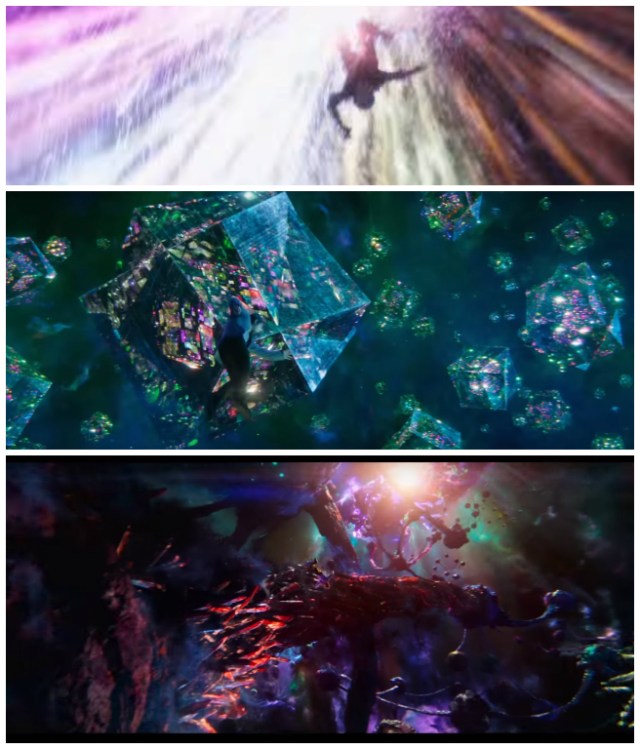
Since all of the previews of Marvel’s forthcoming Doctor Strange movie to date have focused on the impressive yet Inception-inspired visuals of cityscapes folding in on themselves, there has been much nervous talk that the company and director Scott Derrickson would not go full on psychedelic.
Happily, the IMAX featurette released today (see below) can put our little fanboy hearts to rest, for right there, snuck into a piece by Marvel’s head honcho, Kevin Feige, rhapsodising about the comic book genius of artist (and Doctor Strange co-creator) Steve Ditko, is a sequence of visuals guaranteed to bring a smile to the faces of long-time fans (though… nerd alert… it’s a shame neither of the visuals accompanying the talk by Feige are actually drawn by Ditko, but still…).
Obviously (and happily) Marvel and Derrickson have been holding back to reveal too much before the film’s release in November, but these glorious visuals look like a page of Ditko 1960s inspired psychedelia come to life.
As a card carrying (well, FOOM card carrying) Doctor Strange fan since the early 1970s I can honestly say this has me even more excited about what looks like Marvel’s full step into cosmic weirdness.
I’ve got my cloak of levitation and all-seeing Eye of Agamotto ready for November 4th, see you at the cinema!
With Luke Cage seemingly another success for Marvel and Netflix (albeit one receiving more of a mixed signal from critics – and I mean regarding its dramatic qualities, rather than the absurd non-argument about the wonderful diverse cast coming from dull witted racists), excited viewers have been looking towards their next fix for binge watching from this team.
And this weekend at the New York Comic Con, the companies have dropped two fabulous pieces of information. First up, the first, full teaser trailer for Iron Fist (which finished filming just yesterday).
There’s been some discussion from fans of the comics that this might be the show to veer furthest away from its four colour origins, but for those concerned with such things (and you can count this author among those) the signs are encouraging in this latest and more revealing trailer. Full on kung fu action? Check. Dragon tattoo on his chest? Check (Though if he gains that tattoo by fighting with a giant, fiery dragon, a la the comics, I’ll be a monkey’s uncle). Glowing fist of power? Check and double check.
As you can see in the trailer, “The Final Defender Arrives” which leads to the other major morsel dropped by Marvel, that the villain for the big team up series, The Defenders, featuring Daredevil, Jessica Jones, Luke Cage and Iron Fist, is none other than Ripley herself, Sigourney Weaver.
The thought of these superb characters coming together in one, big Netflix-tastic mash up is enticing enough, but the knowledge that they’ll be squaring up against La Weaver is enough to make this must see TV already.
Iron Fist drops March 17th, 2017 while The Defenders is expected to drop later in the year. I’ve already booked my place on the sofa for both!
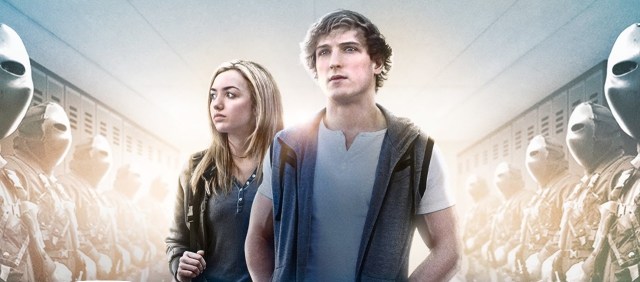
My first thought on seeing this trailer for forthcoming YouTube Red movie, The Thinning, was that it was going to be a story about hair loss.
Introduced by “YouTube star” (it says here) Logan Paul with the words “Hair flip. What’s up?” as he tosses his not quite flowing mushroom bobbed locks to one side, I envisioned this poster child for white male privilege having to endure the horrors of thinning hair during the course of the film, surely ensuring he’d never be allowed to party at Spring Break again.
But no, instead the Young Adult movie is something to do with a whole lot of equally white teens with full heads of hair having to take basic intelligence tests (well, there’s your problem right there, of course). Preying on the fear of exams this seems to entail some shady government plot to cull people with imaginary names (Logan Paul, Peyton List, Calum Worthy… ha ha, Calum Worthy…) who are ejected from their shopping mall utopia to go live with people with bad skin care routines, no Vine account and club cards at Wal-Mart. So basically, it’s a horror movie for people who frequent Urban Outfitters.
Or maybe it’s about killing off the really dumb teens, I couldn’t remember the plot thirty seconds after finishing the trailer, just Logan Paul’s hair.
I’m still trying to work out whether this is one of the most ghastly things I’ll never watch, or if it’s actually a work of genius – a film completely populated by fully-realised CGI simulacrums who have been named by committee (…ha ha, Calum Worthy).
Either way, The Thinning isn’t about hair loss. Which seems like something of a missed opportunity to me. But then I’m not Logan Paul.
Riding the crest of a Blaxploitation wave, Luke Cage was created in 1972 by Archie Goodwin, John Romita, Sr. and George Tuska (with help from Roy Thomas). It’s taken a long time for one of Marvel Comics’ most important black heroes to reach the screen, but boy has it ever been worth the wait.
With this latest series from Netflix, the cooperation between the two companies has really hit a creative peak. Featuring often lower key (but always entertaining) superheroics, touching on hot button topics to give the drama satisfying depth, and with a top notch cast (highlighting beyond due but very welcome diversity, which also extends to the production team behind the cameras), Luke Cage comes in both barrels blazing and feels as unstoppable as its titular hero!
We’re introduced quickly and confidently to the cast of characters – central to which is Harlem itself, given far more of a distinct personality than Hell’s Kitchen in Daredevil and Jessica Jones – in a relatively slow burn first episode, in fact the pacing throughout is charmingly classical, there’s no tearing through ADHD storytelling – everything proceeds at an even, steady tempo, giving characters time to live and breathe and allowing us to understand or care about each one. By about the third episode this approach really starts to pay dividends and then with episode four giving us a revised version of Cage’s origin from the comics, suddenly everything seems to click into place and you realise you’re hooked for the rest of the run. It’s an approach that will give this show long legs and I suspect will play well for repeated viewings (and yes, this is definitely a show that will stand up to more than one watch).
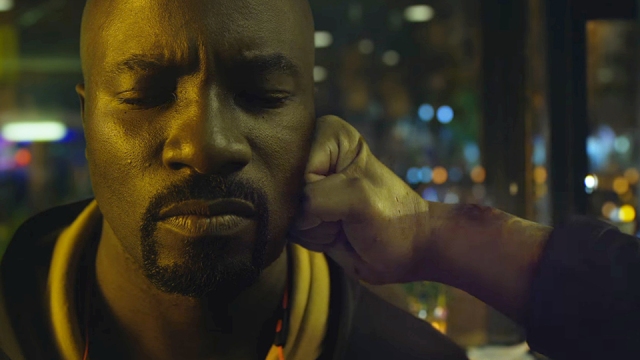
As I mentioned earlier, the cast is uniformly excellent. Colter is magnificent, striding through the episodes like a powerhouse (or even a “Power Man”, a neat in-joke used several time in early episodes – a name used by Cage in the comics), completely owning his show – all quiet dignity with fire and steel just below the surface. Cage is morally conflicted, enough to ensure there’s more than a single layer to enjoy, but at his core he is filled with a sense of righteousness and acts on that until the world forces him to step out of the shadows.
In one scene midway through the season, Cage eulogises the death of a neighbourhood friend and in doing so, gives a stirring speech to rival the kind usually given by the likes of Captain America. Cage is firmly established here as not just as man who will do whatever it takes to get the job done, but as a man to look up to, a hero.
For old time fans longing to see Cage in his traditional comic book outfit of metal headband and yellow blouson, let’s say you won’t be entirely disappointed (though you’ll be glad it doesn’t hang around long – some comic book conceits don’t translate to film). That’s just one of many nods to the character’s four-colour origins and to the wider Marvel Cinematic Universe. There’s also a stronger sense here of the Netflix shows slowly coming together, as we gradually head towards the eventual team-up series, The Defenders (in fact, now we’re only waiting for the last of the key characters to be introduced, in next year’s Iron Fist).
They say a hero is only as good as his or her enemies, and Luke Cage has some great villains. These aren’t pantomime, moustache twirling cardboard cut-outs, however, Mahershala Ali and Alfre Woodard (as Cornell “Cottonmouth” Stokes and Mariah Dillard) are nuanced people, misusing the tools of power and money, both of who believe themselves to be the hero of their particular story. There are great fireworks here, not only between them and Cage, but between each other, and we’re allowed to feel empathy towards them as much as we’re allowed to find their actions repugnant. It’s this kind of layering which elevates drama and what helps to make these shows so engrossing. Cottonmouth and Mariah are fine additions to the Netflix rogue’s gallery established by Vincent D’Onofrio as Wilson Fisk and David Tennant as Killgrave. Ali brings a lizard-like cunning to Cottonmouth and Woodard is sharp and brittle, making it as pleasurable to spend time in their company as with the lead character.
Simone Missick gives us a great Misty Knight, another name which will send frissons of glee through comic book readers, her resolve in the law becoming increasingly conflicted by both the corruption she sees around her and the growing issue of superhuman vigilantes. In fact, she’s so good I’d be interested to see her go onto her own show (and be given the bionic arm she sports in the comic books). There are more than strong suggestions that Knight is already “enhanced”, so the rest wouldn’t be that huge a leap.
On the downside, this still suffers from an overlong running time. Like all of the Marvel/Netflix shows to date it’s at least three or four episodes too long. A more sensible eight to ten episodes per season would really have helped every show, and Luke Cage suffers from some narrative diffusion in later episodes (and a less effective villain) in the season’s second half.
Luke Cage is also gifted with a fine soundtrack, with both its funky as heck, 70s soul-inspired music score as well as excellent diegetic and non-diegetic use of soul, r ‘n’ b, blues and hip hop – the sequence of Cage rampaging through one of the bad guys’ stash houses set to Wu-Tang Clan’s ‘Bring Da Ruckus’ is particularly inspired and indeed, kickass rousing. I can pretty much guarantee you’ll be whooping as Cage smashes his way through armed henchmen using a ripped off car door as a shield. I know I was.
And let’s not beat around the bush here, this is an important show for Marvel, the diversity behind the scenes and onscreen is both vital and energising. The show takes the time to bring in real world issues that affect a community like Harlem, and doesn’t shy away from wider issues of race, diversification and bigotry. It’s all handled deftly and intelligently, mixed in well with the superhero antics.
Marvel TV is already streets ahead of its cinematic kin in terms of diversity, having already headlined its first female lead we’re now given Marvel’s first headlining person of colour (and yes, I know we’re getting Black Panther and Captain Marvel movies, but Netflix will probably be on second seasons of their two shows by the time the films are released). These things are important. They matter. More so than ever in a world where a candidate for the U.S. presidency can openly spout invective of racial hatred. The fact that Marvel hit the target with superb dramatic productions each time is the icing on the cake!
Showrunner Cheo Hodari Coker has done something I wasn’t sure was going to be possible, he’s continued the upward ascendancy of the Marvel/Netflix productions and, Sweet Christmas, he and his talented cast and crew have given us the best version of Luke Cage we could ever hope to get.
Sometimes when watching a movie, one scene can bring that entire film to life, or give you a sense of ownership of that film (or of being owned by it) even when all your critical senses might be fighting against you. This article will be the first in an occasional series where I look at the scenes which do that for me. And today, in honour of the 60th anniversary of Star Trek, I’m going for a doozy!
Released in 1979 and directed by filmmaking great, Robert Wise, Star Trek: The Motion Picture carried a lot of baggage and continues struggling with much of that baggage today.
In the wake of the astonishing box office and cultural success of Star Wars, Paramount Pictures finally gave the greenlight to a long gestating relaunch of their own science-fiction franchise, one which would bring to the big screen the much-loved cast of the CBS TV series, cancelled a decade before.
With a (for its time) astronomically huge budget of around $46 million, mixed reviews from the critics (who found the film ponderous and lacking in the sheer verve of George Lucas’ blockbuster) and less than expected earnings from cinema audiences, the film was considered a failure by some.
Regardless of what might be seen as its failings, there is a scene early in the film so audacious that I can’t help but fall in love with this lopsided puppy every single time.
The story is set some unspecified period of time after the TV show’s five year mission. As a result of a huge, galactic something making its way grumpily towards Earth, wiping out everything and some unfortunate Klingons in its path, a now desk-bound, pen pushing Admiral Kirk (William Shatner, of course) fights his way back into the command seat of Starfleet’s greatest spaceship, the U.S.S. Enterprise.
Transporting up to a station orbiting above the Earth, Kirk is greeted by his old Engineer, Commander Scott, or Scotty with the suspect accent as we know him better (still portrayed by James Doohan). As a plot point, this is done because the still-being-refurbished Enterprise is having some technical issues and its own transporters are out of order (leading to the icky death of some clumsily rematerialized crew members later), however it’s also done to give Star Trek: The Motion Picture its single greatest scene.
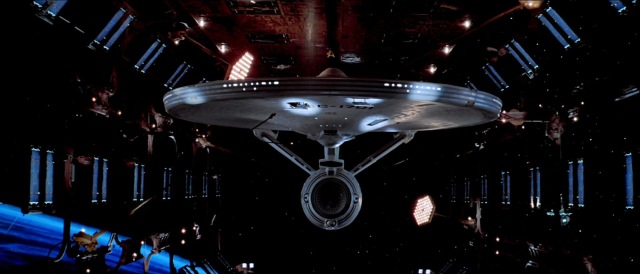
Scotty takes Kirk across to the Enterprise in a small shuttlecraft and both Kirk and the viewer are given tantalising views of the refurbished ship, ablaze in a sea of lights, in a drydock floating in space. The filmmakers referred to their look for the Enterprise as “an ocean liner in space”, and they really hit a home run with it.
As the shuttle draws nearer to the Enterprise, we become Kirk, viewing his beloved spaceship for the first time in years. Jerry Goldsmith’s quite beautiful, rousing and romantic music score underlines both the majesty of the starship and the huge emotions welling up inside Kirk.
At first they move outside the drydock’s frame, flirtatiously teasing us with the beauty inside, the Enterprise’s porcelain curves hidden behind steel and metal. Then Scotty swings the shuttle out wide, letting the drydock’s lacy underwear fall away, revealing the spaceship in all its naked glory.
Scotty cruises the shuttle all around the docked Enterprise allowing Kirk (and us) an intimate view of the ship’s beautiful body, he glides between the wide nacelles like he’s parting the legs of a woman prior to making love, then in an absolute crescendo of visuals and music, he eases the shuttlecraft closer… closer… to the docking port on the Enterprise. The film reaches an almost literal sexual climax as the shuttlecraft enters the Enterprise, joining as one.
Kirk looks at his friend and with a satisfied post-coital tone says, “Thank you, Mr Scott.”
Make no mistake about it, this scene is pornography, plain and simple. It’s hardcore porn that satisfies several fetishes – it’s spaceship porn, special effects porn and out and out Star Trek porn. It shows off the Enterprise lovingly, lustily, it luxuriates in the expertise and skills of the artists and technicians who bring the scene brilliantly to life and it wallows in the characters of Scotty, Kirk and his spaceship amour, the Enterprise. It’s filmed exactly like a love scene, long, sensual shots, music rising and falling with Kirk’s (and our) growing arousal.
The whole scene (from Kirk’s arrival on the space station to the final vehicular penetration) is almost seven minutes long, it serves next to nothing in terms of plot function (the points it does cover could easily be carried elsewhere, and with greater brevity) and in fact, it could be argued that the sequence stops the whole film dead in its tracks. I’d certainly struggle to argue with that.
And yet… the whole thing is played with such breathless devotion to its various fetishes, and with such candour at its intended aims, that what should leave me impatiently drumming my fingers instead has me grinning from ear to ear like a lovesick fool.
It’s pure folly to leave this scene intact, but it’s such a thing of confident and giddy fearlessness to subject a cinema audience to this lust in space that all you can do is surrender to its spunky charm and go with the flow.
After this scene, the film can happily take me wherever it wishes to go. Maybe to even boldly go…
The Neon Demon, directed by Nicolas Winding Refn, sees Elle Fanning’s Jesse, a beautiful small-town girl, moving to L.A. and finding herself negotiating a path through the city’s fashion scene, surrounded by a glistening wave of beauty that’s powered by sinister vampiric urges, full of envy, obsession, necrophilia and cannibalism.
The film moves at a cool, dreamlike, almost ambient pace, a world away from the ADHD editing of a Michael Bay film, but it never meanders, its sense of menace and ugliness building assuredly.
Then Refn goes for a bravura ending, one that has seen people throwing their arms up in disgust and outrage. It’s certainly horrific , but it’s also a thoroughly logical and quite perfect summation, and definitely not easy to forget (should you feel the need to). It’s also very funny, in its own darkly twisted way.
Fanning is terrific in this. It would have been very easy (read: lazy) to have her portray the innocent swept up in terrible events beyond her control, but both actress and filmmakers are too smart for that. The actress plays Jesse with a knowing air – she’s new to the world, certainly, but she’s not unaware of her currency in that world. She knows she’s pretty and that she can make money from being pretty, as her character says.
There are a number of power plays twisting through the cast of characters, and Jesse is at the centre of them: everyone wants something from her and she knows this. But she also wants something from them. Refn plays with the audience’s expectations as to whether or not we should like her as a central character, and it’s this ambiguity that gives her edge.
Both she and the rest of the cast work hard to give their characters inner life, it’s one of Refn’s traits, allowing his actors to fill in the blanks through… well, acting, and it works well here. Jena Malone, Christina Hendricks, Alessandro Nivola, Abbey Lee, Bella Heathcote and Karl Glusman populate Jesse’s orbit, and it’s a fine cast (not to use that word in such a distasteful way as Nivola’s character uses it in the film), while Keanu Reeves is almost unrecognisable as the truly awful dirtbag who runs the motel in which Jesse resides.
Refn is defiantly channelling Dario Argento’s Suspiria here, not just with the colour splashed visuals, but with the whispery, insistent voices of dark magics seeping through every frame, and Cliff Martinez’s electronica beats pulsing and throbbing out a suitably modernist proxy for Goblin. Of course, The Neon Demon doesn’t take place in rain-drenched Munich and Freiburg but in sun-splashed Los Angeles, nevertheless these two films would make a superbly sympathetic double bill. Or, given how brutal each film is, should that be a superbly unsympathetic double bill!?
This would be the perfect point to sing the praises of Natasha Braier’s cinematography, Erin Benach’s costumes and Elliott Hostetter’s production design, all of which are gorgeous. Refn and his collaborators don’t skimp when it comes to replicating the high end excesses of the fashion world, I doubt we’ll be treated to a more visually ravishing movie this year.
This is a filmmaker is in absolute control of his craft, telling the story he wants to tell with precision but, like all great art, forcing the viewer to bring in their own experiences and prejudices. His visual style is all glamour and gloss but the emotions lurk beneath this gossamer thin veneer, they’re dirty and ugly and perfectly 21st century human. The concerns of the film are narcissism fuelled by the fashion industry and by our wider culture, and a hard stare at the way we both deify and objectify young women.
But he’s also asking us to look at the transient nature of beauty in the moment, in the right moment, and at our own need to possess and, ultimately, to kill that beauty. The Neon Demon’s world is one of mixed messages, as is ours.
Is Refn telling us anything we don’t already know or suspect about the fashion industry, or indeed about ourselves? No, but the journey he takes us on while reinforcing that knowledge or those opinions is what makes the story worth telling.
Anyone who thinks The Neon Demon is a case of style over substance has simply been seduced by the sheen. Which is rather one of the points here, no? But those who think this are perhaps cut from the same cloth as those who walked away from Only God Forgives disappointed that it wasn’t two hours of Ryan Gosling wading through fist fights.
Refn’s film has proved to be divisive and that seems justifiable. Like the world it thoroughly eviscerates, you’ll either be utterly repulsed by it or enthralled by it. And that’s great, it’s what I love about both Refn and this movie. This is still fiercely the same director who made the Pusher trilogy, his views of the underbelly still as savage, his filmmaking style still as uncompromising. Refn is punk: vulgar, energetic and wonderful.
You don’t like it!? The Neon Demon seems to be saying almost as a clarion call for Refn’s entire body of work. Okay, great, it’s not for you. Fuck off. If you do, then allow its plumped, sumptuously lipsticked lips to lock onto yours and you’ll be rewarded with the smell of the fetid, rotting meat breath that follows. For me, it’s one of my favourite films of 2016.
The Neon Demon ain’t pretty, but it sure is beautiful.
Gene Wilder, one of the great comic actors has passed away, at the age of 83, from complications of Alzheimer’s disease according to Variety.
Wilder is rightly famed for his many roles partnered up with Mel Brooks or Richard Pryor in The Producers, Blazing Saddles, Young Frankenstein, Silver Streak, and Stir Crazy. And of course, to a generation of filmgoers he was iconic as Willy Wonka, in the 1971 adaptation of Roald Dahl’s story.
The breadth of his career is sometimes overshadowed by these more well-known films, so it’s good to also remember his performances in Death of a Salesman, Bonnie & Clyde, Start the Revolution Without Me, Everything You Always Wanted to Know About Sex* (*But Were Afraid to Ask), The Adventure of Sherlock Holmes’ Smarter Brother and The Frisco Kid.
Growing up in the 1970s Wilder was completely ubiquitous, a part of the cultural fabric of my background. I saw his work with Brooks – Young Frankenstein and Blazing saddles in particular – so many times at the cinema that I could re-enact Wilder’s neurotic, breathless lines by heart.
Wilder once said: “Actors fall into this trap if they missed being loved for who they really were and not for what they could do – sing, dance, joke about – then they take that as love.” If that was a trap, it was one we happily fell into with him.
UPDATE. Wilder’s family just released the following, quite beautiful statement on his passing:
“We understand for all the emotional and physical challenges this situation presented we have been among the lucky ones — this illness-pirate, unlike in so many cases, never stole his ability to recognize those that were closest to him, nor took command of his central-gentle-life affirming core personality. The decision to wait until this time to disclose his condition wasn’t vanity, but more so that the countless young children that would smile or call out to him “there’s Willy Wonka,” would not have to be then exposed to an adult referencing illness or trouble and causing delight to travel to worry, disappointment or confusion. He simply couldn’t bear the idea of one less smile in the world.
He continued to enjoy art, music, and kissing with his leading lady of the last twenty-five years, Karen. He danced down a church aisle at a wedding as parent of the groom and ring bearer, held countless afternoon movie western marathons and delighted in the the company of beloved ones.”
One of the great pleasures of watching so many movies, as I do, is the joy of discovering a film about which you have little or no previous knowledge, which connects with you on different levels and immediately creates a bond which you know will likely be enriched by multiple viewings through the years.
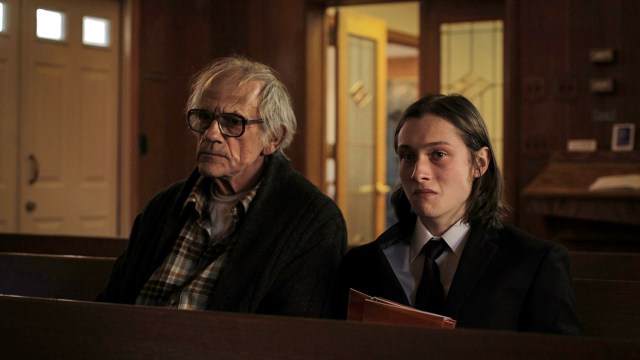
Such is the case with low budget indie chiller, I Am Not A Serial Killer. Based on a 2009 novel by Dan Wells, this adaptation stars Max Records (the child star of Where The Wild Things Are), Laura Fraser (from Breaking Bad) and Christopher Lloyd, and is directed by Billy O’Brien – whose work I’m completely unfamiliar with, but will be paying close attention to from here on.
The plot follows teenager and diagnosed sociopath, John Wayne Cleaver (and what a fabulous name that is for a movie with this title), who must hunt down a grisly serial killer in his hometown.
As well as his diagnosis, Cleaver has to contend with being the son of the local mortuary practitioner in this small community, a fact which makes his life more difficult given the usual high school social conventions. How the young man deals with these conventions is just one of the wonderful detours the film takes while gradually building on the nightmare of the central story.
O’Brien’s Irish produced film (despite being filmed in Minnesota) moves at a deliberate pace and worms its way into your affections primarily down to the central performances by Records and Lloyd.
Records’ character in other, less certain hands could be impossible to like or empathise with, but writing, direction and performance blend to give a layered, textured lead role. Likewise, Lloyd is just a delight to watch, giving us a perfectly measured character who will lead you on quite an emotional journey. It’s a million miles (or more) from his signature role as Doc Brown, in the Back to the Future films.
If some of my descriptions seem a little obtuse, it’s because I have no intention of spoiling the wonderfully warped trip this film takes you on, it’s lo-fi naturalistic style doing its best not to prepare you for the moments (and there are quite a few) when the rug is pulled from under you.
This wry, darkly humourous blend of several different genres, including black comedy, teen coming of age drama, dark crime movie and, well, something else, is ghoulish and nightmarish, but also thoughtful and insightful, full of offbeat observations and several “did that just happen?” moments.
O’Brien’s slyly titled film is, as I’ve mentioned previously, one I’m already looking forward to revisiting, which is a rare enough quality these days . Next time I might skip eating beforehand, though…





 out of dave's head