
My Favourite Scene – Spaceship Porn (a Star Trek anniversary special)

star-trek-the-motion-picture-02

Sometimes when watching a movie, one scene can bring that entire film to life, or give you a sense of ownership of that film (or of being owned by it) even when all your critical senses might be fighting against you. This article will be the first in an occasional series where I look at the scenes which do that for me. And today, in honour of the 60th anniversary of Star Trek, I’m going for a doozy!

Released in 1979 and directed by filmmaking great, Robert Wise, Star Trek: The Motion Picture carried a lot of baggage and continues struggling with much of that baggage today.

In the wake of the astonishing box office and cultural success of Star Wars, Paramount Pictures finally gave the greenlight to a long gestating relaunch of their own science-fiction franchise, one which would bring to the big screen the much-loved cast of the CBS TV series, cancelled a decade before.

With a (for its time) astronomically huge budget of around $46 million, mixed reviews from the critics (who found the film ponderous and lacking in the sheer verve of George Lucas’ blockbuster) and less than expected earnings from cinema audiences, the film was considered a failure by some.

Regardless of what might be seen as its failings, there is a scene early in the film so audacious that I can’t help but fall in love with this lopsided puppy every single time.

The story is set some unspecified period of time after the TV show’s five year mission. As a result of a huge, galactic something making its way grumpily towards Earth, wiping out everything and some unfortunate Klingons in its path, a now desk-bound, pen pushing Admiral Kirk (William Shatner, of course) fights his way back into the command seat of Starfleet’s greatest spaceship, the U.S.S. Enterprise.

Transporting up to a station orbiting above the Earth, Kirk is greeted by his old Engineer, Commander Scott, or Scotty with the suspect accent as we know him better (still portrayed by James Doohan). As a plot point, this is done because the still-being-refurbished Enterprise is having some technical issues and its own transporters are out of order (leading to the icky death of some clumsily rematerialized crew members later), however it’s also done to give Star Trek: The Motion Picture its single greatest scene.

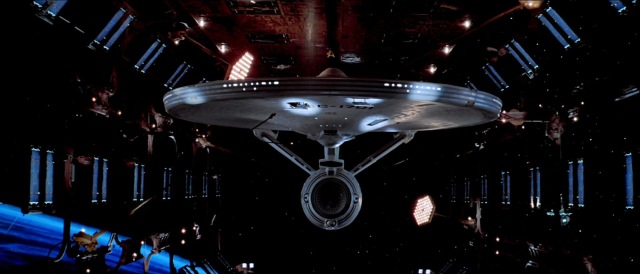
Scotty takes Kirk across to the Enterprise in a small shuttlecraft and both Kirk and the viewer are given tantalising views of the refurbished ship, ablaze in a sea of lights, in a drydock floating in space. The filmmakers referred to their look for the Enterprise as “an ocean liner in space”, and they really hit a home run with it.

As the shuttle draws nearer to the Enterprise, we become Kirk, viewing his beloved spaceship for the first time in years. Jerry Goldsmith’s quite beautiful, rousing and romantic music score underlines both the majesty of the starship and the huge emotions welling up inside Kirk.

At first they move outside the drydock’s frame, flirtatiously teasing us with the beauty inside, the Enterprise’s porcelain curves hidden behind steel and metal. Then Scotty swings the shuttle out wide, letting the drydock’s lacy underwear fall away, revealing the spaceship in all its naked glory.

Scotty cruises the shuttle all around the docked Enterprise allowing Kirk (and us) an intimate view of the ship’s beautiful body, he glides between the wide nacelles like he’s parting the legs of a woman prior to making love, then in an absolute crescendo of visuals and music, he eases the shuttlecraft closer… closer… to the docking port on the Enterprise. The film reaches an almost literal sexual climax as the shuttlecraft enters the Enterprise, joining as one.

Kirk looks at his friend and with a satisfied post-coital tone says, “Thank you, Mr Scott.”

Make no mistake about it, this scene is pornography, plain and simple. It’s hardcore porn that satisfies several fetishes – it’s spaceship porn, special effects porn and out and out Star Trek porn. It shows off the Enterprise lovingly, lustily, it luxuriates in the expertise and skills of the artists and technicians who bring the scene brilliantly to life and it wallows in the characters of Scotty, Kirk and his spaceship amour, the Enterprise. It’s filmed exactly like a love scene, long, sensual shots, music rising and falling with Kirk’s (and our) growing arousal.

The whole scene (from Kirk’s arrival on the space station to the final vehicular penetration) is almost seven minutes long, it serves next to nothing in terms of plot function (the points it does cover could easily be carried elsewhere, and with greater brevity) and in fact, it could be argued that the sequence stops the whole film dead in its tracks. I’d certainly struggle to argue with that.

And yet… the whole thing is played with such breathless devotion to its various fetishes, and with such candour at its intended aims, that what should leave me impatiently drumming my fingers instead has me grinning from ear to ear like a lovesick fool.

It’s pure folly to leave this scene intact, but it’s such a thing of confident and giddy fearlessness to subject a cinema audience to this lust in space that all you can do is surrender to its spunky charm and go with the flow.

After this scene, the film can happily take me wherever it wishes to go. Maybe to even boldly go…

https://www.youtube.com/watch?v=b52b4yORX6U

Welcome back, Jean-Claude Van Johnson

JCVJfinal

There are certain sentences you never expect to find yourself typing, one of those being: the funniest show on TV right now is executive produced by Ridley Scott and features 1980s action movie star, Jean-Claude Van Damme.

But there it is. One of three new comedy episodes aired by Amazon for their pilot season, the fate of the shows will be determined by the responses they receive, and I can only hope that by spreading the word like this, I’ll be helping Jean-Claude Van Johnson go to a full series, because it’s something quite special.

The story posits that Van-Damme has been appearing in B-grade actioners for years simply as a smokescreen for his real job, a covert ops agent. The episode opens with him in the midst of ennui-riddled retirement, gliding around his magnificent home on a Segway and microwaving Pop Tarts.

A chance encounter with the love of his life at a pop-up ramen restaurant sees him hankering to get back into the field, but age has taken its toll and he’s no longer quite the splits-capable Muscles from Brussels  of younger days.

Van Damme has eased into a fine and often remarkably subtle comic talent, providing laughs big and small, frequently at his own expense, and the writers and producers have garnished their star with some finely observed and detail-driven humour (note the parade of dog photos he walks past in his living room, or the name of the community that houses his mansion – Circles On The Point – literally, going nowhere). That the episode ends with a reworking of the theme song from 1970s sit-com Welcome Back, Kotter is perhaps the final topping on this Belgian waffle.

If this goes to series (and you should all go out and watch this now, then write to Amazon, your local broadcaster, MPs, doctors, vets and anyone else who’ll listen to your pleadings), I hope it continues to mine the rich seams of self-depreciation and even poignancy that run deep throughout the pilot.

And really, who doesn’t want to see Jean-Claude get out of the house more to beat people up!? Or get beaten up himself, as is likely the case here.

Welcome back for the first time, JCVJ.

Netflix’s Power Man & Iron Fist get real!

heroesforhire-610x395
As an avowed Marvel Comics geek from way, way back (heck, I was even a member of F.O.O.M. – the Friends of Ol’ Marvel fan club – in the 1970s, and still have my membership card), I’ve been following the rise of Marvel’s film and TV properties with great excitement and enthusiasm. The fact that their productions are of a high standard has pleased me all the more.

After the huge success of the Netflix Daredevil show (the second season was given the green light virtually hours after the first one dropped to big ratings for the channel), it was genuinely thrilling to see them pushing ahead with some of Marvel’s lesser known properties.

Jessica Jones also proved to be a hit, and now here we are with trailers for not only Luke Cage but also Iron Fist. We’ll speak more of these guys after you’ve feasted your eyes on the trailers:

https://www.youtube.com/watch?v=Ymw5uvViqPU


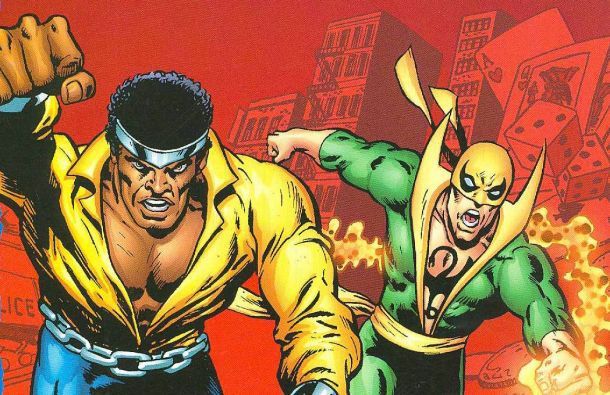
Cage, created in 1972 by Archie Goodwin and John Romita Sr.(with help from Roy Thomas), and Iron Fist (AKA Danny Rand), created by Roy Thomas and Gil Kane in 1974, were attempts by Marvel to capitalize on the Blaxploitation and Kung Fu crazes, but were later paired up as Power Man & Iron Fist – Heroes for Hire.

So it’s genuinely thrilling to see these second tier characters emerging to digital life (in the shape of Mike Colter and Finn Jones), especially as both look set to kick some major ass. I’m now hoping we’ll see Marvel dig a little deeper and give us major productions for Forbush Man and Frog Man (try Googling them) or, dare I even whisper it, Howard the Duck (after his cameo in Guardians of the Galaxy)!

Meanwhile, Luke Cage drops on September 30, 2016 and Iron Fist hits sometime in 2017.

UPDATE: As if that wasn’t enough excitement from Netflix for one day, we’ve also been treated to the first teaser (set to Nirvana’s Come As You Are, no less) for The Defenders, the show which will see all their characters team up. It’s a Marvel-icious overload:

https://www.youtube.com/watch?v=xvCFjG8f_AM


Stranger Things – More King Than King

stranger-things-homages

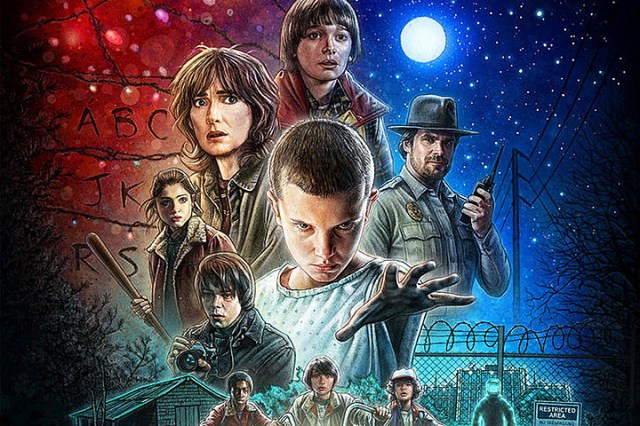
The Netflix series that flew in pretty much under the radar and is now the water cooler show of the summer feels like one of the best Stephen King adaptations ever – even though the author has nothing to do with Stranger Things.

Of course the eight part series doesn’t just reference King, there are a lot more ingredients mixed into this charming concoction – everything from Alien and Aliens, John Carpenter movies (plus a massively Carpenter-inspired score, by Kyle Dixon & Michael Stein), The Gate, The Monster Squad, Blow Out, A Nightmare on Elm Street, Scanners, Videodrome and a whole lot more. It’s also a love letter to the 1980s movies of Steven Spielberg, particularly E.T.; The Extra Terrestrial and The Goonies, as well as to the decade itself (during which the show is set).

But most of all, the film calls back to Stephen King books, films and TV series such as Firestarter, The Tommyknockers, Stand By Me and many more. Creators/co-producers and directors Matt and Ross Duffer get to the heart of what makes King’s work so successful, by giving us ordinary, down-to-earth (and decidedly blue collar) characters who we come to care for. It seems like a simple trick, but it’s one that proves elusive to many.

When 12-year-old Will Byers vanishes, his mother, Joyce, becomes frantic and tries to find him, while the local Police Chief, Jim Hopper begins his own investigation. The very next day a mysterious girl with strange abilities appears. These events soon start to involve others in the small town, including a dark government agency with their own agenda involving these two children.

The casting here, by Carmen Cuba, deserves special mention and is superb. The children give really likeable and heartfelt performances, with special mention going to Millie Bobby Brown, Gaten Matarazzo, Caleb McLaughlin and Finn Wolfhard.

Every character gets moments to shine, and even those we’re supposed to dislike get real moments of humanity. The biggest exception to this is chief antagonist Dr. Martin Brenner, played by Matthew Modine (channeling David Cronenberg in Clive Barker’s Nightbreed, perhaps?), who remains cold and unknowable. I’m not certain if this is a deliberate choice of the production but it serves to leave something of a hole at the centre of things.

Of the adults, both Winona Ryder, as Joyce, and David Harbour, as Jim Hopper, give very strong, anchoring performances. Hopper really is the quintessential Stephen King protagonist, the cracked and frayed working man who becomes heroic despite his frailties.

Mixing horror and science fiction with big dollops of humour and heart (the relationships between the four central children are not only relatable but warm and very funny, and there are some real tear-inducing moments between them), Stranger Things, despite a small, niggling feeling of anti-climax, tells a mostly satisfactory, self-contained story – though I’m sure its surprise success will have many viewers calling for more – and there are certainly enough threads left hanging.

While there’s nothing startlingly original here, the way these ingredients are prepared feels both fresh and familiar, and the show is a hoot for those who know and love any of the productions I’ve mentioned (or just the 1980s) but more than stands on its own feet to provide a summer surprise which will keep you glued to your sofa.

King himself took to Twitter to praise the show, saying “Watching STRANGER THINGS is like watching Steve King’s Greatest Hits. I mean that in a good way”, and if it’s good enough for the master of horror, well…

Summer is Coming – Game of Thrones Threatens Vacation Industry.

jon-snow-resurrected

The entire summer vacation industry came under threat today when HBO announced that Game of Thrones season 7 would move its broadcast date to summer 2017.

Hoteliers, package airlines and sun lotion manufacturers expressed dismay at the announcement. “I felt a great disturbance in the Force,” said a spokesperson for them, quoting the wrong franchise “As if millions of voices suddenly cried out in terror and were suddenly silenced.”

“Now that winter has arrived on ‘Game of Thrones,’ executive producers David Benioff and D.B. Weiss felt that the storylines of the next season would be better served by starting production a little later than usual, when the weather is changing,” said Casey Bloys, president, HBO programming, completely ignoring the pain inflicted on so many people. “Instead of the show’s traditional spring debut, we’re moving the debut to summer to accommodate the shooting schedule.”

Adding insult to injury, the producers have also announced the final two seasons would be considerably shorter, consisting of approximately six to eight episodes each. Quite how the world will deal with this double blow and whether or not vacation related industries will ever recover remain to be seen, but it certainly looks like our vacation tans will be lacking for the next two summers.

Source: Variety

Star Trek And Chill!

Star-Trek-2017-TV-Series-Logo

In news sure to excite Netflix subscribers around the world, the new Star Trek TV series will head to the channel in 2017.

The still untitled series will air in the U.S. and Canada on the CBS All Access channel, but Netflix has secured worldwide rights (outside of these two countries) for its 188 territories, and each episode will be broadcast within 24 hours of its U.S. premiere.

This is fantastic news to everyone except torrent pirates (who were no doubt expecting a torrent party with the show only airing on the CBS exclusive channel), and adds to the already huge buzz about the first Star Trek TV production since Scott Bakula and crew sailed off into the galactic sunset with Star Trek: Enterprise, in 2005.

Additionally, and in a move certainly intended to build and prime a new audience for the new series, all 727 existing episodes of the iconic Star Trek television library – including Star Trek: The Original Series, Star Trek: The Next Generation, Star Trek: Deep Space Nine, Star Trek: Voyager and the previously mentioned Star Trek: Enterprise will be available on Netflix around the world by the end of 2016.

Alex Kurtzman and Bryan Fuller are co-creators and executive producers for the new Star Trek, based on Gene Roddenberry’s original series. Fuller launched his career writing for Star Trek: Deep Space Nine and Star Trek: Voyager, and created highly regarded TV series including Dead Like Me, Pushing Daisies and the sorely-missed Hannibal. Kurtzman is co-writer and producer of the blockbuster films Star Trek and, rather less thrillingly, Star Trek Into Darkness.

Set to begin airing in January 2017, we can only hope this show carries on the pioneering spirit of Roddenberry’s original series, which aired from 1966 – 1969 and was followed by a slew of movies and TV shows.

Between this news, positive word of mouth on the new feature film, Star Trek Beyond, and Paramount’s announcement that Star Trek 4 will move ahead with the current movie crew and with Chris Hemsworth reprising his role as Kirk’s father, George (last seen sacrificing his life for his wife and son in the 2009 reboot), it seems there’s still going to be plenty of chances for man and woman to go boldly beyond the franchise’s 50th anniversary!

Source: Netflix

Uncle Bill and Isao Tomita

snowflakes5963

I’ll always be grateful to Uncle Bill. I grew up in a block of flats, surrounded by a lovely, close-knit set of neighbours and my favourite amongst them all was Bill Bartlett who, with his wife Connie, lived directly below us. Bill and Connie loved music, particularly Barry White, and they had a big sheepskin rug in front of their fireplace – which they always intimated they made love on while listening to the Walrus of Love.

Uncle Bill, as I affectionately called him, was a cultured man who introduced me to art, photography and music, he would help me with my homework and we would listen to jazz, soul and electronica. Isao Tomita’s Snowflakes Are Dancing (based on the work of Claude Debussy) was released in 1974 and Uncle Bill adored it, playing it endlessly as we sat on their balcony, flitting between my schoolwork and books of photography (and cheekily allowing me a cold glass of beer if it was a hot summer evening – I was about twelve or thirteen, these were different times).

Tomita, of course, was one of the pioneers of electronic music and a hugely influential and important figure in the worlds of  music, film and animation. He composed the theme song and incidental music for Osamu Tezuka’s animated television series Jangaru Taitei (Jungle Emperor), released in the West (albeit not with Tomita’s theme music) as Kimba, The White Lion. He also created music for films and television shows such as Catastrophe 1999, The Prophecies of Nostradamus (U.S. title: Last Days of Planet Earth), Zatoichi and Mighty Jack, and in the wake of Snowflakes Are Dancing, released a number of classically themed albums of electronica, including Igor Stravinsky’s The Firebird, Modest Mussorgsky’s Pictures at an Exhibition, and Gustav Holst’s The Planets.

Uncle Bill passed away several years ago, having left a vast, indelible mark on my life, and now Isao Tomita, one of the pioneers of electronic music, has joined him. I hope the two of them are sharing a cold beer together, somewhere as warm and loved as the very special place they inhabit in my memories.

C’est la guerre – High Drama in Netflix’s Marseille

Marseilles

Coming to the end of 25 years as mayor of Marseille, Robert Taro, played by Gerard Depardieu, is pulled into a war of succession by his formerly loyal protégé and deputy, Lucas Barres (Benoît Magimel), and the stage is set for a series of betrayals and revelations, with the criminal underworld of the city never far away.

Created by Dan Franck (author of both novel and screenplay of the movie, La Séparation), Marseille represents a big move for Netflix, as it’s their first globally high profile, native language show – a move to be unquestionably applauded – and so what kind of bang do we get for our Euro here?

Beginning and ending with Depardieu’s mighty frame snorting coke at the Stade Velodrome while Olympique de Marseille entertain the masses, like some debauched Roman emperor at the Coliseum, in between we’re treated to all manner of political and personal chicanery, leading to an ending which is all kinds of wonderfully over the top grand opera.

Depardieu just about manages to keep his character this side of sympathetic, but even after eight episodes it’s difficult not to feel that though he’s obviously having fun there’s nothing really stretching him, and needs a few big scenes with some salty dialogue to show what he’s really capable of.

Benoît Magimel, as the mayor’s seemingly loyal deputy, fares a little better, striding through the show trailing a mixture of charm, slime and grit but always managing to give us glimpses of the humanity beneath. Géraldine Pailhas and Stéphane Caillard as Taro’s wife and daughter respectively, are interesting but not massively fleshed out yet (a trait levelled against many of the supporting characters), it would be good to see both actors provided with a little more fire in their roles.

Netflix’s latest high profile drama series might lazily be described as a Gaelic House of Cards, but that would be doing both shows a disservice as each paints with a different palette. Franck’s show gives the city itself a richer identity, encompassing a more diverse social, economic and racial tapestry, which gives it a very distinct flavour to its network stablemate.

The show is atmospheric and engaging, unfortunately favouring style over substance, but when everyone is scheming, backstabbing and fucking with such glee it’s hard not to get wrapped up in the grimy fun. There might be nothing here we’ve not seen before, drama-wise, but the sheer French-ness of it all makes it an utterly compelling divertissement. And the show is likeable enough to hope that a second season might fill out the charming flesh on display and put a little more meat on the bones.

Unlike the French national anthem there’s nothing particularly revolutionary in Marseille, but it’s all done with such beaucoup de gusto that you won’t mind.