

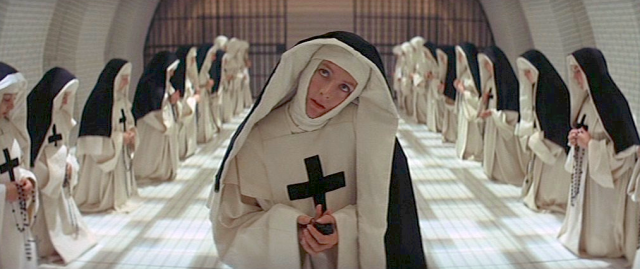
It’s easy to understand why Warner Bros would allow Ken Russell to film a lavish adaptation of Aldous Huxley’s book, The Devils of Loudon. It’s less easy to understand why the studio that produced the film seems so reluctant for audiences to see it today.
Russell rode the incredible wave of British film directors that still impresses today, along with the likes of Nicolas Roeg, Tony Richardson and Lindsay Anderson. So, coming fresh off the success of Russell’s adaptation of D H Lawrence’s Women in Love for United Artists in 1969, with critical praise, good box office and an Academy Award (for Best Actress, Glenda Jackson), Warner Bros were keen to climb on-board the Russell train. When Russell pitched the idea to make his screenplay – originally written for U.A. before they pulled out of the project, based partly on Huxley’s book from 1952 and partly on the 1960 play The Devils by John Whiting – the studio agreed to give the project the greenlight.
The book, play and Russell’s film, all dramatise real life events that took place in Loudon, France, in the 17th century. Cardinal Richelieu and Louis XIII were attempting to stem the power of Protestant towns such as Loudon, and found themselves in conflict with the town’s very earthly priest, Father Grandier, and decided to turn to their advantage a series of supernatural possessions which seemingly afflicted the town’s Ursuline convent, presided over by the sexually obsessed Sister Jeanne des Anges.
Russell delivered a bold, profound and outrageous movie, with astonishing set design from Derek Jarman, a dissonant score from Peter Maxwell Davies and blistering performances from stars Oliver Reed, as Grandier, and Vanessa Redgrave, as Sister Jeanne.
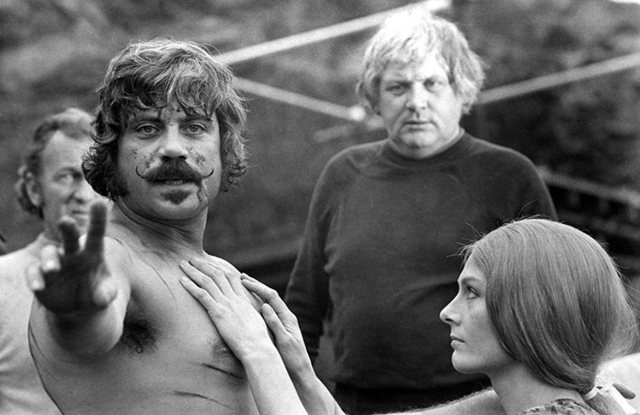
The studio’s love affair with film and director ended harshly. Both the British Board of Film Censors and Warner Bros. itself demanded heavy cuts for its sexual, violent and religious content before granting an ‘X’ certificate in the UK and further drastic cuts were inflicted by the studio for the film’s release in the USA. The publicity for its American release clearly showed the studio’s discomfort over the film, defensively exclaiming, “The Devils is not a film for everyone” on posters and in trailers. This severely truncated edit would be the only version deemed acceptable by the studio for the following decades, at least in the countries where it wasn’t already banned. In fact, the film has not received an official release on home video in the U.S.A. since a VHS issue in 1995.
In 2002, journalist/broadcaster Mark Kermode (who cites as influence an important article by Tim Lucas detailing the various cuts imposed on then extant home video versions of The Devils, from the September 1996 issue of Video Watchdog magazine) uncovered footage cut from the film that had long been considered lost, including the infamous Rape of Christ sequence (in which the hysterical nuns sexually assault a statue of Christ), and in 2004 a restoration of the film reinstated much of this footage. Over the next few years, this fullest, uncensored version ever assembled since Russell’s original cut in 1971 was shown to great acclaim on many occasions at public screenings around the world, with the hope that Warner Bros would respond to the call for an official release.
After much negotiation with Warner Bros., the British Film Institute was allowed to release a disc of The Devils in 2012. Despite having access to the 2004 restoration however, Warner Bros refused to hand over any original film materials for a new high definition transfer and instead presented the BFI with a digi-beta tape of the original British X certificate version, meaning they could only release the 1971 cut and only on DVD.
Hell on Earth: The Desecration and Resurrection of The Devils, the Paul Joyce documentary presented by Mark Kermode that had screened on the UK’s Channel 4 in 2002 complete with the Rape of Christ sequence, was included on the disc’s supplementary features. Warner Bros refused permission for the sequence to be used at all on the disc and so even the documentary had to be cut. The uncut version of the documentary remains viewable on YouTube as of this writing, and despite being hobbled by Warner Bros, the features-packed disc remains an essential purchase. These bizarre restrictions certainly raise the questions of why Warner Bros would not furnish the BFI with appropriate materials, and why the studio still considers the Rape of Christ sequence off limits.
In May of 2013 I screened the X certificate cut of The Devils to a full house at my own Dave’s Movie & Music Nights in Volda, Norway and I’m proud to say that in over four years of screenings I have never seen an audience quite so affected by a film. Afterwards people stayed in their chairs, wanting to process what they had just seen, eager to discuss it. Certainly, they were shocked by the film, but they were also astonished, moved and stimulated by it. And this rather, is the point here: The Devils is not a film you can watch passively, love it or hate it this is a film which invites (…actually, demands) a reaction from the audience. Once viewed, it will not easily be forgotten. Can we ask more from a film?
Not long after the screening, while discussing the film with Russell’s last wife, Lisi Tribble (who had written a beautiful and personal introduction for me to read to attendees) the idea was hatched between us to start a campaign to help secure a release of the restored, uncensored director’s cut.
With Mrs Russell’s blessing and active participation, we have managed to get a number of high profile organisations, culture sites, directors, producers and writers to support the campaign on social media, tweeting and retweeting the hashtag #FreeTheDevils and generally voicing their wish for the film to be released. The campaign page on Facebook, Free Ken Russell’s The Devils, now has almost four and a half thousand followers.

In October 2015, a high profile screening of a beautiful 35mm print of The Devils took place at the Egyptian Theatre in Los Angeles, as part of Beyond Fest, to a sold out and hugely appreciative audience who were treated to an introduction and Q & A session by director and campaign supporter, Bernard Rose (Candyman, Immortal Beloved, etc.).
Rose is hardly alone in his love for The Devils; Guillermo Del Toro has spoken publicly and forcefully on many occasions on his lack of comprehension at Warner’s stonewalling. At a 2014 masterclass given by Del Toro in Toronto, the director said of the film’s lack of availability, “It’s not an accident. It’s not because of lack of demand. It’s a true act of censorship. It’s extremely blatant,”
While the film is challenging and divisive, it also inspires great passion in those who see the sincerity and anger of the film’s themes, and the humour and boundless creativity at work.
With a film that clearly inspires such depth of feeling and such a vocal following, why then does Warner Bros make such harsh demands on the few home video releases it receives? Why do they not recognise the commercial possibilities in a respectful release? If it is true they hold their film in such disregard, why not license it out to a boutique label such as Criterion or Arrow to release?
Of course there are many films still awaiting release on home video in any form, but The Devils is not some half-forgotten B film with a handful of cult movie fans clamouring for its release, it is instead a prestige production from one of cinema’s most controversial and acclaimed directors. It seems bewildering that Russell’s film has received such spotty releases around the world, and remains virtually invisible in the USA.
Rumours persist that one or a number of Warner Bros executives were deeply offended by the film and its message in 1971, and that this remains at the core of the film’s relative lack of visibility over the years. If there is any truth to these rumours, that offense must have been powerful indeed, as few of the same executives still work at the studio. Of course, American culture still faces a great deal of resistance from its deeply fundamentalist states, so it is almost certain that Warner Bros is fearful of religious and moral opposition if they were seen to support Russell’s film, but this fact alone cannot account for their attitude.
The strange truth is that Warner Bros has yet to make any kind of definitive public response or statement on the years of calls for the film to be released on home cinema in a manner accorded to its status. This silence naturally raises many questions on the reasoning behind Russell’s film receiving such poor treatment. For a studio to neglect a forgotten gem is hard enough to understand in this age of multiple digital platforms, but to wilfully ignore a bona fide classic that has such strong support is unforgivable.
When so many movies that hit the multiplexes today are bland, morally vacuous or assembled by corporate committees to sell lunchboxes and toys, Russell’s film should be lauded, now more than ever, as the extraordinary and extraordinarily powerful, fiercely intelligent and boundary breaking piece of work it is. The studio that made The Devils should not be ashamed of their production, but instead should celebrate it with the release of a prestige presentation in an optimum format.
It is time for Warner Bros to do right by their long neglected masterpiece, to show due respect to this wildest, most savage, outrageous and courageous work by one of cinema’s true and much missed original voices.
Written by Dave King
* This article originally appeared (in a slightly modified version) in Z filmtidsskrift magazine #1 (2016), translated into Norwegian by Ingrid Rommetveit, and the issue editor was Helene Aalborg
 *Spoiler-free review*
 out of dave's head